(If you have not read the prologue, start here)
Traveling through unfamiliar places with a friend, I begin to see even the self I thought I knew in a slightly different light.
It was only four in the morning when I left home to catch the first bullet train into the mountains of central Japan. It felt less like early morning than the middle of the night. Yet even at that hour, security guards were walking the streets, night workers were changing shifts, and supermarkets were beginning to receive their supplies. Someone was loading the back of a minivan with great bundles of fabric—a linen laundry service, perhaps. In the streets before dawn, I could clearly see the usually invisible work that keeps an enormous city like Tokyo running.
At Tokyo Station, it took about thirty minutes to pack my bicycle into its travel bag. When I finished and happened to look up, the sky was glowing with dawn. There is so little sky to see between Tokyo’s skyscrapers, but even that sliver was beautiful.
I had allowed extra time for the ride from home to Tokyo Station, extra time for packing the bike, and extra time for shopping and taking photographs inside the station. After piling margin upon margin, I was ready far earlier than necessary. But my friend had the tickets, so there I stood outside the gates, with nothing to do but wait for him.
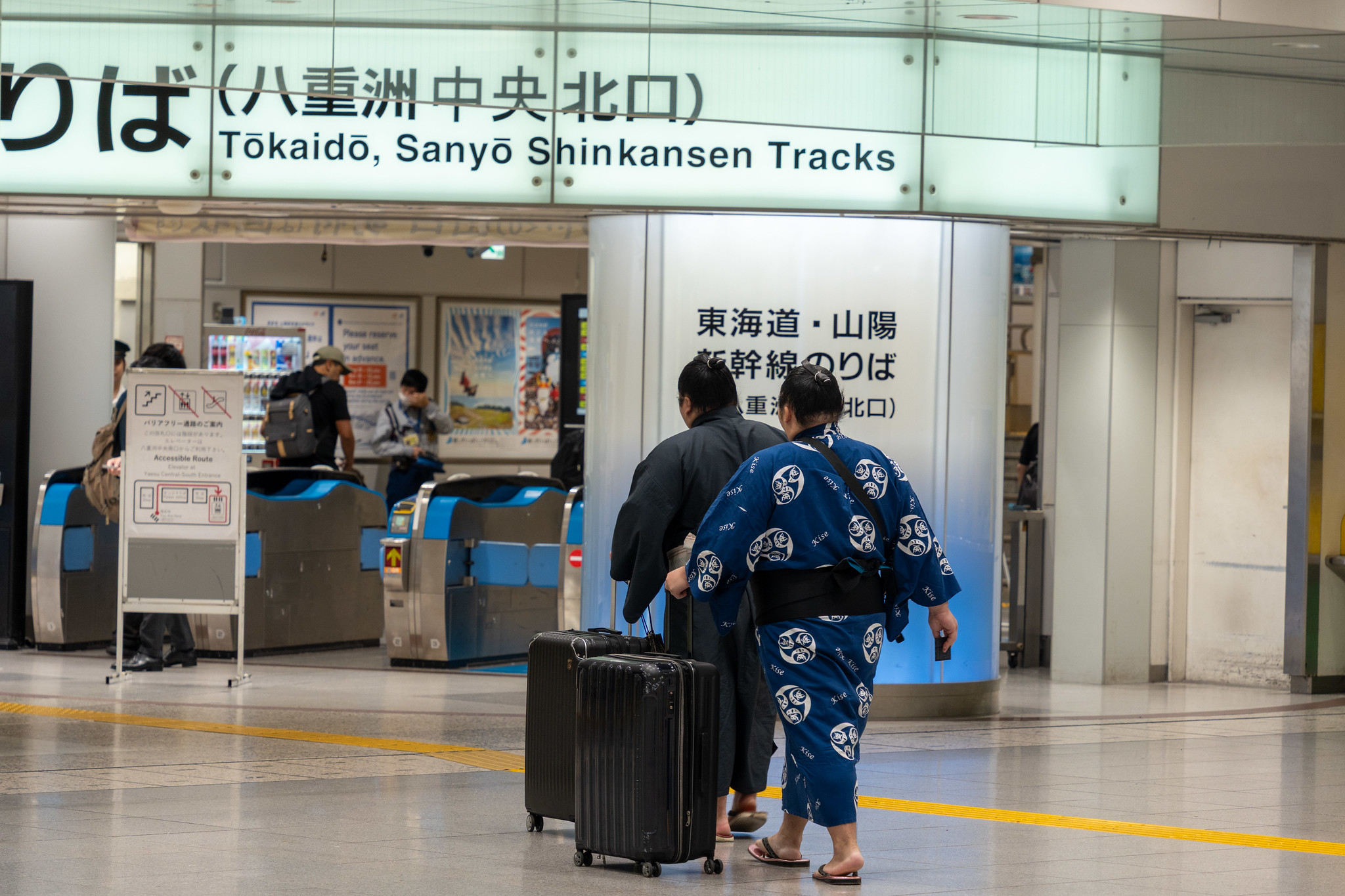
Just as I was beginning to watch the clock anxiously, he strode up, said something about a credit card, and went looking for an ATM. Without wasting a second waiting around, he boarded the train five minutes before departure—and then, astonishingly, stepped back onto the platform to pull off a little shopping at the kiosk as well. What impressed me was how calmly he did it all, without a trace of hurry.
Such efficiency! You could only do that with a very precise understanding of how long each task takes and how much margin it needs. Having things ready to do if a spare moment appears is another habit I would find hard to imitate. So this is how busy people operate.
Discoveries like this are part of the pleasure of traveling with someone. With us both aboard, and these thoughts still turning in my head, the train slipped out of Tokyo Station so smoothly I barely noticed, precisely on time. How very Japanese.
Beyond the metropolitan area, fields of ripened rice began to appear. Many had already been harvested. I could feel how the season had moved on since my trip through northern Japan in May. Up in the highlands, occasional trees in autumn color were drifting past the window, glowing in the morning sun. Autumn! The changing seasons in this country really are beautiful.
But my mind was still going over what had happened at Tokyo Station. Arriving early may be a virtue, but it is also the flip side of my fear of being late, of missing the train. It comes at a cost too: wasted time. I want to remain aware of how anxiety influences my behavior, and to keep it from shaping what I do. That is something I have been working on more intentionally in middle age.
Even if I missed one bullet train, the next would be only thirty minutes later. There was no great need to worry. Having missed a flight myself, I know there is something to be said for experiencing a fear come true and discovering that it is not, after all, the end of the world.
When I am with my family, I am usually the least anxious one, the one cutting things closest. Being on the other side was a fresh experience. Ah, so this is what it looks like to everyone else.
On the other hand, I had enjoyed some leisurely people-watching at Tokyo Station in the early morning, and I regretted not getting a photograph of the train before departure. There are things that slip through the net of efficiency.
Between these reflections and catching up with my friend, the journey passed in no time. Before eight, we stepped out into the chill at an old castle town called Ueda, reassembled our bicycles, and set off. Now then—what kind of journey would this one be?

The town was full of a six-coin crest, the emblem of the samurai family that once ruled here. Yet in the next town, barely ten kilometers away, the local hero was a rival warlord who had fought against them. Had they really been fighting over territories this small?
We crossed a small bridge and followed the embankment along the upper reaches of the Shinano, dragonflies dancing around us. Autumn in Japan, distilled into a single scene. To our left was a hot-spring town with its old, mid-twentieth-century atmosphere intact. It filled me with nostalgia.
Eventually the road began climbing the hillside toward Obasute. The rice terraces I had read about! The climb gained less than two hundred meters, but some stretches, especially along the farm roads, were steep enough to leave me doing nothing but pedaling. The autumn breeze felt lovely.
An arrow marked “rice terraces” tempted us off our planned route. Before long we found ourselves on a brutally steep slope, with a dead end at the top. Alone, I would have turned around in disappointment. But my friend suggested we might get back to the road by passing beside the house ahead, and started walking with his bicycle in his arms. After a small adventure skirting the eaves of someone’s home, we made it safely back to the road.
At the top of the climb stood a little train station. Small and quiet, it suited the beautiful landscape spread out below it. We crossed the footbridge over the tracks, took photographs from the platform, and spent a little while in that lovely stillness.

As I let my heart open to the space around me, I thought again of the woodblock print near the entrance. The name Obasute evokes a bleak legend: a son carrying his elderly mother on his back into the mountains to abandon her. In the print depicting this subject, the old woman’s gentle expression showed her still thinking of her child even as she accepted death. The son’s face looked merely resolute; I could see no anguish or inner struggle there. But the old woman had an extraordinary power to move me. As someone who does a little drawing, I was moved by the artist’s ability too. Having children of my own may also have had something to do with it. Unexpectedly, for reasons I could not quite explain, my heart overflowed and I cried.
So this is what a picture can do. A tiny face, drawn with just a few lines, as in so many Japanese woodblock prints. Perhaps that expression gives the viewer’s imagination somewhere to settle, and so stirs the heart. In other words, less can be more.
The explanation beside it, though—the written version of the legend—cooled my feelings instead. A tyrannical lord orders that the elderly be abandoned. The son disobeys and hides his mother. Her knowledge then proves useful, and the lord changes his mind. I understand the message about respecting the wisdom of the old. But does a person have no reason to exist unless they are useful? It felt as though this contrived moral tale had pushed aside the quiet tenderness that could move anyone’s heart, reducing it to a supporting role.
Thinking about the connection I had made with this place, I climbed back onto my bicycle. We enjoyed the gentle, winding descent toward the river. The apple orchards scattered among the terraces had left such an impression that I stopped at a roadside bakery for apple bread to satisfy my craving.
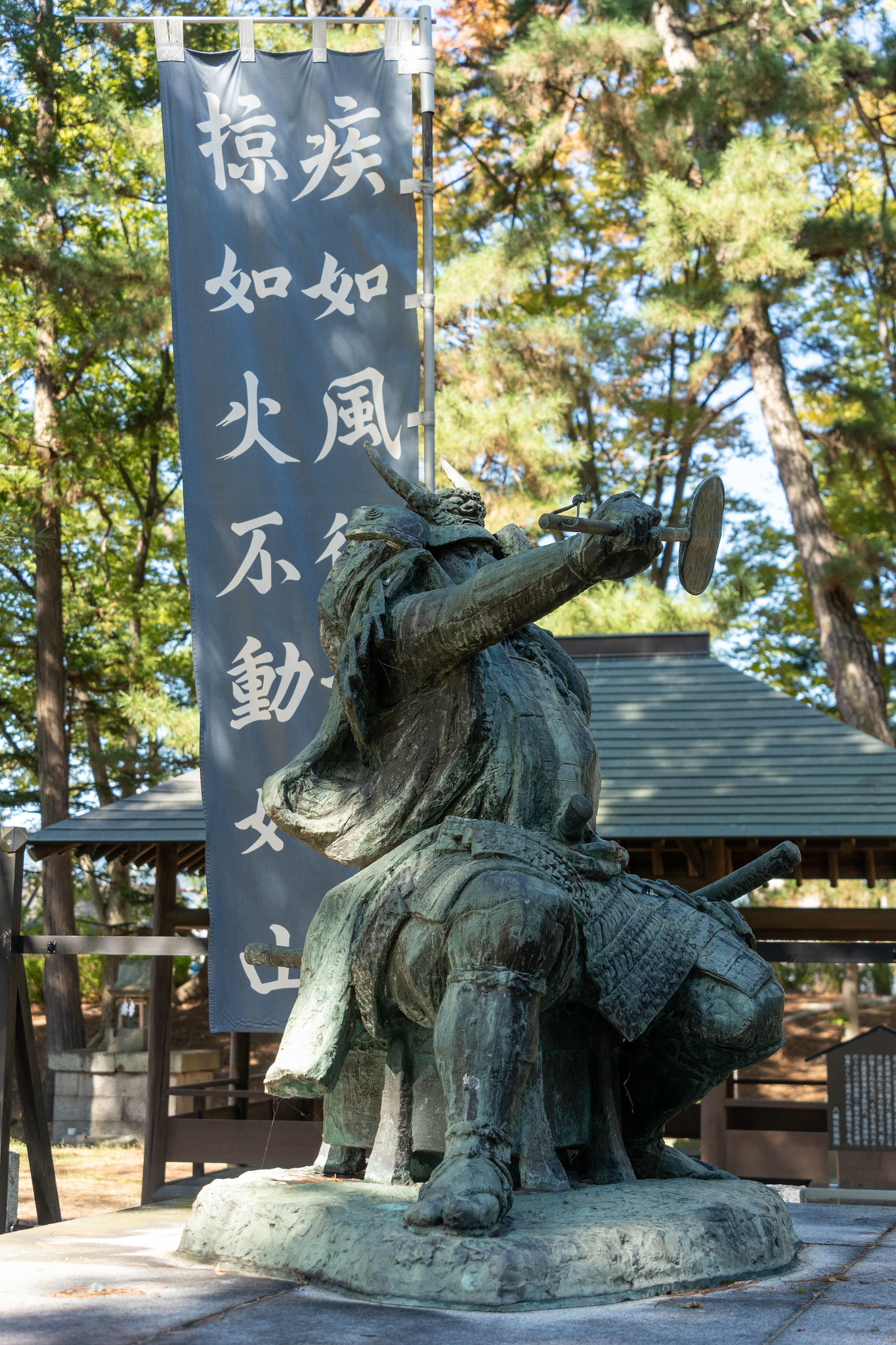
A little farther on came a battlefield famous for a legendary duel between two warlords. One strikes down from horseback; the other, seated, blocks the blow with an iron war fan. Is there anyone in Japan who does not know that image? Sure enough, a magnificent bronze statue in the park captured the scene with tremendous energy. It is also well known that this exchange of blows may never actually have happened. You could call it a convenient fabrication. Lately, though, I have come to see something positive in it.
It makes me think about how difficult it is to communicate something. On this trip I saw many works capturing that moment: the duel painted on a large platter, the two warlords’ faces on a pair of enormous kites. Obviously, it’s not that we can invent history as we please. But the wide-ranging conflict between their clans is a fairly abstract thing. With this anecdote as a sharp focal point, a single recurring motif, that conflict was reaching more people, more vividly. There is value in that too.

Next was a grand Buddhist pilgrimage temple. There is no shortage of things to see around here. It was impressive, but I did not feel the immense sense of prayer I had felt at a temple on my earlier journey through northern Japan. That says nothing against this temple; I simply did not form a connection with it. The connection I did make, instead, was with a restaurant tucked quietly into the residential streets behind it.
When I travel, I hate to spend one of my precious meals somewhere “uninteresting,” like a nationwide chain. But finding a good place in an unfamiliar town is not easy. This restaurant was probably a converted home. I could not see inside, and hesitated a little before opening the sliding door. My friend led the way, and I followed him into a room bustling with locals, artfully designed dishes and bowls displayed in every available space. An elderly woman, whose movements were a little impaired, was slowly serving the food. Time itself seemed to move gently here. I knew at once that this was a good place, full of character.
I was hungry enough that the lunch set of local mushrooms and chicken was clearly not going to be enough. “That seared bonito you were carrying just now looked delicious. Could we have some too?” I asked. She looked pleased, and her reaction warmed my heart a little as well.

Perhaps intrigued by these customers who kept asking for more rice, the proprietor eventually spoke to us through the little kitchen window. You’re on bicycles? How far are you going? What, all the way to Akita? How far today? Our destination was still several days’ ride to the north. Hearing his surprise, I saw our adventure afresh. Not only the six hundred kilometers, but how lucky I was to be have a whopping five whole days, and a friend to share such an adventure with. Our journey seemed capable of stirring something in other people too. I felt proud.
With our stomachs full of delightful local dishes, we stepped outside in high spirits and were getting ready to leave when the proprietor came after us with the sunglasses we had forgotten. Lunch on the first day had become exactly what I had hoped for: a chance to connect with local people, as well as to refuel.
Perhaps what I felt was reassurance. Before this trip, I had been cycling in Italy. I spoke no Italian, and the Italians I met struggled with English. Opportunities to connect had been few. Yet here, by lunchtime on the very first day, a connection like this was already possible. If this was how the journey was beginning, the rest promised to be wonderful. I was reminded of the pleasures of traveling in Japan. My shoes clicked into the pedals, and the sound brought me into focus.
Farther downstream, the Shinano River abruptly enters a narrow gorge. It was easy to imagine the history of flooding here: when the river swelled, the water could not all pass through this constriction and spilled out instead. This river gave the surrounding region the flat land that made settlement possible, but it also brought repeated floods. Cycling through Japan, I see so clearly how deeply rivers have carved this country.
A vast flood-retention basin was under construction. The heavy machinery working inside it looked like tiny beans, dwarfed by the soft colors and shapes of the earth. A little farther on, at the river’s critical choke point, I looked up to see a bullet-train viaduct spanning the water and disappearing into a tunnel on the opposite bank. Beautiful geometric forms, the solidity of concrete, the power of high-voltage lines. Engineering beauty, refined.
It does not avoid the most dangerous point of a dangerous river. Nor does it challenge that natural force to a head-on contest of strength. Instead, it seems to understand its “opponent,” calculate the risks, and make the necessary provisions—then lightly sidestep the danger. It even turns the narrowness of the river into the advantage of a shorter bridge, stepping across as though it were nothing at all.
Hidden from the people riding the train is an immense accumulation of calculation, deliberation, experience, and preparation. Human ingenuity at its finest. Looking at this unruffled viaduct rising into the sky, I felt a brilliance almost as though modern civil engineering were standing tall, radiant with pride. One of the heights technology has reached in the eternal struggle between people and rivers.
Not layer upon layer of precautions born of anxiety, but a clear understanding, the right preparation, and the freedom to move lightly. Wasn’t that the beauty I had sensed in the way my friend handled things at Tokyo Station this morning? A person and a bridge are very different things, but there was something shared in what had drawn me to each.

From here, the road ran between the winding Shinano River and a single-track railway, with hardly a car in sight. Beautiful scenes followed one after another. Onions were set out to dry here and there—a local custom, perhaps. In a place like this, I felt I could cycle forever. The little two-car trains fitted the landscape perfectly. Why should a scene I had never seen before fill me with nostalgia?
Our destination for the day was a hot-spring village in ski country. At the end of the ride, we stopped for supplies at the only general store within a ten-kilometer radius, and what a lovely place it was. It was like stepping back in time. It took me back to high school and university, when I was obsessed with skiing. After a happy day on the slopes, my friends and I would come to shops like this at night for beer and other supplies, our breath white in the cold. The friend riding beside me now was there in some of those memories too, both of us much younger.

The woman tending the shop was a sweet, kind elderly lady. She liked to talk, and what began as idle conversation became a warm stretch of time spent chatting. A moment when a stranger’s life crosses mine, and a stranger is no longer quite a stranger. I told her how much it had helped us to find her shop open, with no convenience stores or anything else around. She said she wanted to retire, but her children would not take over, and she could not close because the people nearby would be left in difficulty. She said it partly in jest, but I sensed plenty of truth beneath it. She was so kind that I could vividly imagine her being unable to stop when her neighbors told her they needed her. In fact, without this shop, we ourselves would have had no breakfast for the next morning.
As I rattled the sliding door closed behind us, hung the shopping bag from my handlebars, and pointed my bicycle toward our lodging just behind the shop, a thought occurred to me. Perhaps our gratitude had added a little more weight to the burden on her shoulders. I felt she was entitled to put herself first a little more. Perhaps this was connected, somewhere, to the unease I had felt reading the legend of the abandoned mother that morning. One shouldn’t have to justify their existence through their usefulness.
I wished I had asked what kind of life she would want after closing the shop. On the other hand, continuing to run it must have held all sorts of meaning too. I wished we could have talked about the joy the shop brought her, rather than what she did for others. It was not for me to say which she should choose. But I wanted that choice to come from her own wishes, rather than the needs of the people around her.
Our hotel, too, was a ski lodge straight out of those days. A room big enough to sleep eight, with the toilets and washbasins outside the room. After such an early start, I fell asleep almost at once. Life was becoming simpler.