(If you have not read the prologue, start here)
My own legs carry me along on this journey, but the words I exchange with others do a surprising amount of the work.
At five in the morning, still in the half-light, my friend and I descended a gentle slope. Countless cottony clouds had settled against the mountainsides, crowding together. The intricate shapes of ridgelines disappearing into cloud made an otherworldly landscape. Like ants crawling along one of those slopes, we too passed into clouds and out again, in and out. Each time, soft moisture wrapped around us. Houses emerged dimly from the mist, then vanished. A cemetery. Houses and stones alike were dark with damp.
When we reached the river, vapor was rising from its entire surface. A faint breeze gathered it together, then swept it away, as though another, invisible river were flowing above the water. The green beside the river was so deep it had become black. Through it, only the road and the single-track railway traced gentle curves, inviting us onward, beyond this scene.
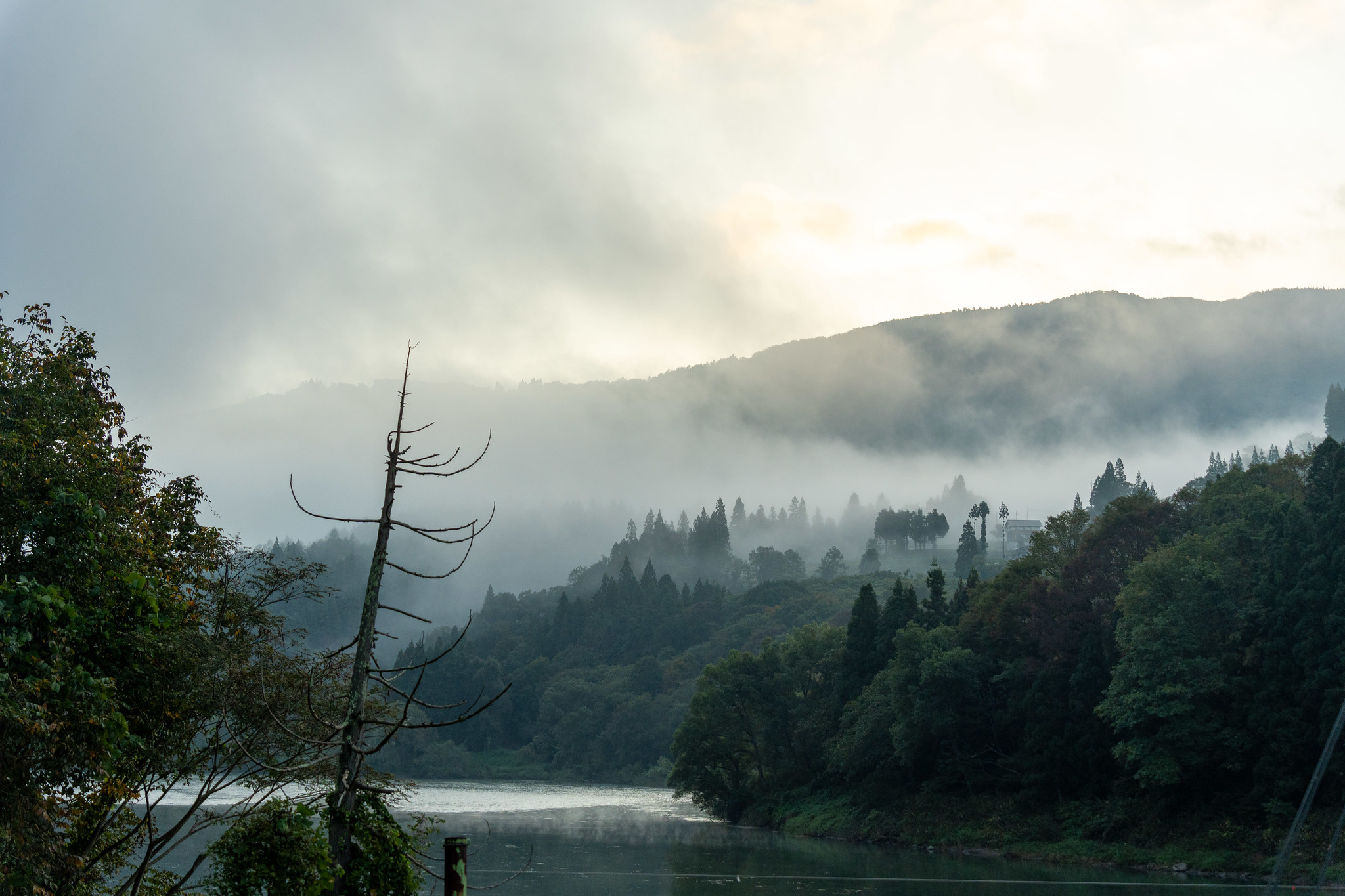
It was so quiet. A railway crossing stood silent, its yellow insisting on its presence. Only the faint sound of my bicycle wheels turning offered reassurance. A house with a great red roof had its curtains drawn so completely that I could not even tell whether anyone lived there. In contrast to the dark colors enveloping the ground, soft shades shifted across the sky. Purple into orange. The long twilight lent these hours their calm.
That beautiful, peaceful interval ended abruptly. The sky brightened, and time seemed to accelerate like a river approaching a waterfall. Sunrise was near. Color drained from our surroundings until the world was reduced to two shades: dazzling orange and black. Fallen leaves on the asphalt began casting long, sharply defined shadows. Bright sunlight beyond a tunnel made its interior pitch-black.
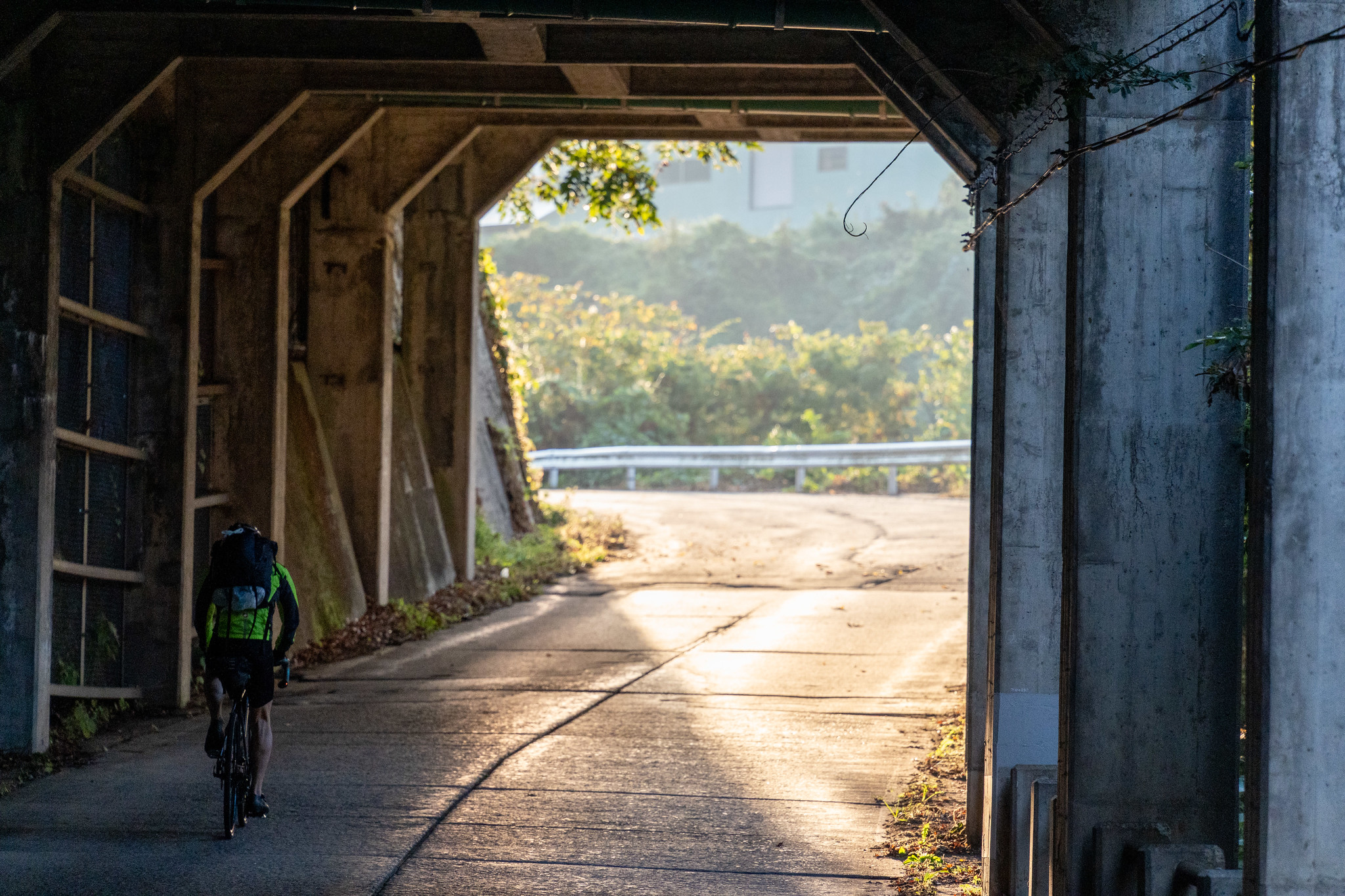
I emerged from the tunnel and basked in the light of a new day. Now I knew how a lizard felt. Brown and green fields, the white walls of houses. On a mossy black stone wall stood eight little Buddhist guardian statues, their red hoods lined up in a row. Color returned as abruptly as it had disappeared. That straight line of red heads stayed vividly with me.
Perhaps three hours had passed altogether. Absorbed in taking photographs as we rode, I had forgotten the cold, and the time had flown.
Until now, I had thought of this mountainous region of central Japan rather vaguely as a large prefecture. This journey changed that impression completely. Its area may be vast, but most of it is mountainous land that people cannot use. What shapes the region’s topology is a maze-like network of corridors carved by rivers, joined at key points by mountain passes.
Preparing for junior high school entrance exams, I had spent social studies lessons diligently filling blank maps with mountain ranges and rivers. So this was what I should have been learning then, I thought. No one had explained why it mattered, and it had felt like meaningless work. If I could send a message to my younger self, I would tell him how fascinating it is that terrain sets the stage for the human world.

We passed an old hydroelectric dam. Amid the soft forms of nature stood a structure that was large, but not too large. Its straight lines, clean angles, and circular arcs spoke of human endeavor. Built sometime in the mid-twentieth century, perhaps. The moss and rust stirred a nostalgia for the good old days. I hesitated, wondering whether we could stop there, then saw a motorcycle crossing the dam and decided to follow. Its rider was taking photographs too, and we exchanged a few words. He was the first stranger we had encountered that day. In the way he said, “It’s lovely here, isn’t it?” I felt a shared appreciation. A small connection, a small joy. We wished each other a safe journey and parted.
In one mountain village, a tunnel off the main road was marked “School Route.” Really? I wondered, only to come upon an elementary school. In contrast to the little village’s aging buildings, it was so new and handsome that it almost seemed out of place. In a region whose population was presumably dwindling, I sensed a wish to give at least the children, who would carry its future, a good environment. It moved me. Someone, perhaps a teacher who had stayed overnight, was preparing alone to welcome them. The roads here climbed and dropped steeply. Our journey continued.

Farther downstream, the mountains seemed to be loosening their grip. From here onward, the land formed river terraces. Each surface was flat, but the road climbed or descended as it crossed from one level to another. The shapes of the roofs and the height of the posts marking the road edges told us we were in snow country. My reading before the trip had taught me that this area was rich in prehistoric settlements, so we stopped at one. Inside a reconstructed thatched house, it was dark and quite damp. Poor ventilation, smells that would surely linger: it seemed a fairly harsh place to live. Then again, perhaps a fire would create an updraft and ventilate the room. Or perhaps I had spent so much time cycling that my body was simply rejecting the indoors.
The highlight of the day was a coffee shop in Tokamachi, the weaving town I had read about before the trip. I was tired from riding a monotonous stretch of road, and I also wanted to make some connection with this town, which had fascinated me in my reading, rather than simply pass through. Its people had turned the very conditions of snow country into distinctive local products, with the deftness of a beautifully executed judo throw. Their ingenuity had left a strong impression on me. Yet I still had no faces to put to those people. Before leaving, I wanted to meet a real, flesh-and-blood person who lived here.
While waiting at a traffic light, I happened to notice a shop across the road and decided, entirely on impulse, to stop.
Sliding open the door and stepping inside felt less like entering a shop than visiting someone’s home. Furniture, a piano, a stove, countless little objects, each with its own history, I imagined. Everywhere I looked, there were traces of a life lived here. The older woman looking after the shop seemed a little surprised, but soon made us coffee. She seemed curious about us too, and sat down at our table to talk.
She seemed to have been born and raised in the area and to have lived here all her life. The life in snow country she described sounded anything but easy, yet love for her corner of Japan shone through her words. The breathtaking silver world on a clear day after snowfall. Her belief that snow was a blessing. Her worry about the price of kerosene. Borrowing her eyes, I tried to imagine what it would mean to live here myself.
After a while, her husband came downstairs. He had a gentle face, weathered by the years, and I remember how stylishly he was dressed for someone just going about his day. Taking one look at us, he told his wife, “Unusual visitors today. Better soak up some energy from these young people.” Soon he too joined the conversation. His words and manner suggested that, for their part, they valued the chance to get to know these “young” travelers from elsewhere. That made me happy.

We lingered over that precious time together, then reluctantly got up: there was still a long way to go today. She gave us some sweets to take with us, and both of them came all the way outside to see us off. I had received things both tangible and intangible from them, but what made me especially happy was the sense that we had given them a little time that mattered too. “Come back,” they said as we parted. I very much wanted to.

In the next town, we visited places connected with a samurai leader who could see that the samurai era was ending, yet believed that his samurai code of honor forbade switching to the winning side. In other words, if your values demand that you lose out, then you’d better lose out with dignity and honor. His name was Kawai Tsugunosuke, and I had found him so fascinating in my reading that I wrote a whole post about him. I was thrilled to find that the restaurant where he is said to have eaten lunch after his peace negotiations broke down was still in business, and decided to eat there.
This was a crucial moment not only in his life, but for the whole domain he led. The negotiations had quickly unraveled. He knew they had failed, but with so much at stake, he couldn’t just give up. He waited alone in this restaurant while his servant tried to find an opening for renewed negotiations. Hours passed as he waited, hoping for a last-minute breakthrough, knowing it probably wouldn’t come. Can you imagine what it must have been like? I hoped the visit might bring some new feeling or insight about him.
At the entrance was a large poster for a film about him. We sat facing a small but carefully tended Japanese garden. We had come a long way north, but it was still too early for autumn. The menu effectively offered just one meal, which I liked. Leave it to the professionals to decide what is good: one of the pleasures of Japan. The Japanese dishes arrived in an elegant lacquered box. I kept asking for more rice, and by the third bowl they apparently began to worry; I was amused when they told me there would be an extra charge. Perhaps they had overheard me telling my friend Kawai’s story, because they asked whether I would like to see the room he had used. They let me take photographs.
I spent some time in the room, but found nothing there to deepen the emotion his story had stirred in me. What had happened here already played vividly in my mind, like a scene from a film. I had simply invented the room’s size and layout. So this was what it actually looked like, I thought. But that did not change the reasons his life had moved me.

The restaurant was busy that day with all sorts of groups: older women reminiscing, apparently at a school reunion, and a young woman who had brought her grandmother out for something delicious. As befitted a fine traditional restaurant, it was quiet, but unmistakable ripples of happiness filled the dining room. I felt as though I alone were looking at a different time from everyone else there. There was a trace of loneliness in that.
After lunch, we visited the temple where those negotiations had actually taken place. Only a few weathered stone monuments evoked those days, and I can no longer remember what they were. But I remember clearly the kindergarten next door, and the children singing inside. Little shoes lined up beneath the eaves. One lay upside down, perhaps kicked off in a hurry. Human life goes on. Looking back, I think that’s what I took away from that town.
The next city had a museum devoted to Kawai. I parked my bicycle, thinking we might make a quick visit. But a look at the forecast showed rain moving in, so we decided to press on. We also made a quick stop at the nearby birthplace of Japan’s naval commander in the Pacific War, Admiral Yamamoto. A small two-story house, with low ceilings and steep stairs. In the tiny room said to have been his study, just two tatami mats in size, I tried to imagine him sitting there.
The admiral’s birthplace also had a poster for a film about him, and, amusingly, the same actor played both men. Two posters with almost identical compositions.
Perhaps that was why I sensed something in common between these two men from this region. The samurai could see that the shoguns’ era was ending, yet his sense of honor would not let him join the new government’s forces. The admiral believed Japan could not win the Pacific War, yet said he could run wild for six months or a year, but had no confidence if the war lasted two or three years. I would love to ask people here what they think of these two men.
Leaving the city, we followed the embankment along the Shinano River. It was not a cycle path, but there was little traffic, making it more pleasant than the national highway. On the other hand, neither the view nor the gradient changed, and it grew monotonous. We had already covered some 110 kilometers, and my body was fairly tired. Mentally, stretches like this can be the hardest of all.
At times like this, a break is in order. In fact, we had reached a great diversion channel built to carry the river’s floodwaters away, and I had wanted to visit the museum beside it. The Shinano had accompanied us throughout this journey. Since the beginning of recorded history, it had brought both bounty and flooding to the mountain valleys upstream. This channel was modern Japan’s answer to that river.

But the rain forecast worried us, so we hurried on. The radar showed a band of heavy rain advancing slowly south from the Sea of Japan. We were heading north. Who would reach the hotel first, us or the rain?
Then came another unwelcome surprise. The coastal national highway leading to our hotel was closed. There was only one road squeezed between the mountains and the sea; if we could not use it, we would have to approach from the other side. That would add about 100 meters of climbing, and make getting caught in the rain inevitable. I wanted to avoid rain in the mountains, especially on a descent. Could we wait it out somewhere? But riding wet roads through deserted mountains after dark was frightening too. If the rain was light, perhaps we should keep going. I wanted to think calmly, yet every moment felt urgent: I wanted to arrive before the rain. Thoughts tangled in my head until I could no longer make a decision.
On a recent solo cycling trip in Italy, I had also been caught in a thunderstorm and found myself in danger. Conditions worsen little by little, until you cannot tell at what point the situation has become a crisis. That memory was growing stronger in my mind. I wanted to draw on that experience and handle things better this time…
As I rode with my thoughts still in turmoil, the rain began. Around the time we crossed a bridge over the railway, it became a downpour. There was no riding on in this. We hurried under the eaves of a 7-Eleven.
The shortcomings in my planning hit home. What would we do if it rained? If we had a mechanical problem? Had I checked road closures along the route? These were obvious questions to ask myself. I had thought about these things when planning the trip, but here and there I had counted on getting lucky. Now the rain had caught us at exactly one of those weak spots.

The rain only grew heavier. While I wasted time on regrets, my friend spotted that our hotel offered a shuttle to the nearest station. My sense of responsibility as the trip’s leader, and the lessons of Italy, overcame both my dislike of phone calls and my reluctance to ask for help. I called, explained the situation, and asked whether they could pick us up. The response was roughly that they could come later if there was really no alternative, but would prefer us to wait for the rain to stop and make our own way there.
There would be no immediate rescue, but I now had the reassurance that, in the worst case, we could wait here and help would come. The endless downward slide into anxiety and fear stopped.
The person at the hotel also offered exactly the right advice: take shelter in the laundromat next door. Inside, it was warm, out of the wind, and there were chairs. We could stop our wet bodies from losing heat and draining our strength. I even recovered enough composure to take photographs of the scene outside.
Judgment might seem to be a matter of intellect and logic, but I think it is far more physical than that. I learned that, rather than rushing to make a decision, the important thing is first to create the conditions in which you can make a good one.
In fact, after about thirty minutes, the rain stopped. The clouds broke, and even a little sunshine appeared. While waiting, we had also been able to work out our route to the hotel. We resumed riding, crossed a mountain, and arrived safely before dark.
We had come through the crisis safely, and I could feel that I had handled it better than before. It had given the trip a much stronger sense of adventure, making it unforgettable. After all, the unexpected is part of what makes travel interesting.
The hotel faced the Sea of Japan. We watched the sun sink into the sea, enjoyed the outdoor bath, and had an excellent tasting flight of local sake with dinner, which they had thrown in when we said we would not need breakfast. I was thoroughly content.

It had been a long day of travel, yet there was still so much we had to skip. The museum of the region’s traditional crepe-woven fabric. The museum devoted to the samurai whose life had fascinated me. We had had to pass by the great diversion channel too. The actual journey could not keep up with the richness of my prep reading. Perhaps it would be fun to return by car, crossing off the things we had missed. And then I could go back to that older couple’s coffee shop in the weaving town! Chance may bring us a connection, but nurturing it takes effort and intention. That is something I have been thinking about lately.