(If you have not read the prologue, start here)
Rivers, towns, even food begin to look a little different once you understand their connections with people.

Once again, we rose with the sun and got on our bicycles. Northward we went, watching the dawn colors over sea and sky. The morning sea was quiet, and calmed my mind. The coast here was rugged too, its varied terrain keeping boredom at bay. As the land opened into a broad plain, we reached a belt of coastal dunes. On a bicycle, your legs register every rise and fall of the sand. My legs insisted I was climbing, while the sea insisted I was not. What was going on here?

Feeling bad about having tired my friend out yesterday, I thought it might be better to let him set the pace. It turned out he was much faster than me: he vanished from sight almost immediately, and I could not catch him. So much for my conceited assumption that he was slower and I had been pushing him too hard. I asked to take the lead again. What sort of muscles let someone who barely cycles ride more than 100 kilometers a day for five days straight? It seemed reckless, but perhaps even thinking that was unfair, given that he could actually do it. In any case, I was amazed.
We rode through the port city at the river’s mouth, the biggest city on our route north. It was quiet on an early Saturday morning, and stopped at a Japanese sweets shop standing open almost alone among the closed office buildings. We ate ohagi, rice sweets coated in sweet bean paste, made with the new rice harvest. “Wherever I go, I can count on sweets shops to be open early, which is wonderful,” I said to the woman behind the counter. “But why are you open at this hour on a Saturday in an office district with nobody around?” She laughed.

Four kilometers from its mouth, we crossed the Shinano, Japan’s longest river, for the last time on this trip. Two diversion channels must have reduced its volume considerably, yet it still had the bearing of a great river, flowing with unhurried dignity. We had followed it for days, all the way from our starting point in the mountains. Along the way, we had met all sorts of people, seen the bounty and flooding the river brought, and learned something of the lives people had built in response. Here we would say goodbye. I felt the same reluctance to part that I might with someone I had befriended on the road.
I did not want simply to ride past, so I stopped to take photographs. I wished I had told some elementary school children back near our starting point, “We’re going all the way to the end of this river.” They might not be able to picture a distance of 300 kilometers, but surely they would be curious about what lay at its end. I had been that way as a child. A national highway ran near our house. One day, leafing through maps of the greater Tokyo region at home, I discovered that it stretched unimaginably far. To my younger self, the mountains of central Japan were a distant land reached aboard an express train. Yet if I kept following a road in my own neighborhood, I could arrive in that “distant land.” Near and far were connected by solid ground. Only now, at this age, had I gained the ability to make those imagined journeys real. And on the same kind of vehicle I had used back then: a bicycle.
The sun was up, and my body was warm. We were parting with our friend the Shinano, but our journey would continue. The road out of the city led through working-class neighborhoods, with factories lining the roadside. There was a used-car buying business with signs in Russian. Did the cars bought here travel across the sea to Russia? Human enterprise always finds a vigorous way across borders. A man stood with a smartphone to his ear, apparently making a call. His features looked Russian too.

Our next stop was an old samurai town. We paused for a little sightseeing and discovered, to my surprise, that the castle grounds were still in active use as a base for Japan’s modern army. From inside the castle, we could see jeeps and other equipment lined up. It felt as though several centuries of military technology had been brought together before our eyes. I wondered why such a cramped site in the middle of town was still being used as a base, but left without finding out.
With time to spare, we also visited a Japanese garden. Trees placed here and there around a pond. A stepping-stone path weaving between them. I had thought of the buildings I saw in France and Italy as pinnacles of beauty born of their lands, cultures, and histories. Here, I felt deeply that a Japanese garden was another such pinnacle. As I walked around the pond, foreground and distance kept changing. The absence of symmetry also meant that no view repeated itself.

In the mood for ramen, I searched and found an old-fashioned diner nearby. It seemed to have been left untouched for decades. The door rattled as we opened it, and inside it was quite busy. One of the customers called toward the back, “You’ve got customers!” Even that stirred my nostalgia. They told us the place had been in business for seventy years. So perhaps this was the second or third generation. A timetable for the nearby train station hung on the wall. Manga were stacked beneath the window. Memories of childhood trips with my grandparents came back. Yes, this was exactly what diners used to be like.
The ramen suited the place perfectly: a wonderful bowl with a gentle flavor that made me want to use the old-fashioned name for it, “Chinese noodles.” How lovely that places like this were still genuinely loved.

One thing troubled me, though: the owner was terribly harsh with his wife, who worked alongside him. He spoke sharply over little things, such as how much change we were owed, and his irritation was palpable. If someone spoke to you that way all the time, at work and at home, wouldn’t your spirit begin to shrink? I wanted to say something about how uncomfortable it made me, but could not find the words, and left without speaking up. My silence felt like a small act of complicity, and it stayed with me for some time. Disappointment in myself, I suppose.
I do not think I needed to make it so complicated. “Careful, keep talking to your wife like that and she’ll kick your butt one of these days!” It would only have been an outsider’s impression from a fleeting encounter, without knowing their circumstances. If it failed to reach him, what would that really matter? But if my impression had touched on something true, perhaps the small comments of different outsiders could accumulate and eventually get through. Courage need not always mean some grand act. It might also mean offering a small gesture, in a small way.

Beyond the town, choosing roads away from the main highway gave us a wonderful route through peaceful, rolling farmland. My friend was delighted, and I could appreciate the beauty intellectually, but it was a shame that my sore backside kept me from giving it my full attention. Riding this much day after day, some physical ups and downs were inevitable. Stranger still was the way I would naturally begin to feel better if I simply kept going.
As we drew closer to the town where we would spend the night, we passed a busy shopping complex on the right, something like a roadside rest stop. Something about it drew me in, and I turned around to investigate. It was a fish market by the harbor. A lively fish market full of people is a pleasure in itself, and this one also sold all sorts of things to take home. An improbably enthusiastic, catchy song about the market, probably sung by a local pop idol, played on an endless loop and instantly brainwashed me. Coming to a market always makes me want to buy the fish, take it home, and cook!

I had been wanting to eat a local specialty before leaving the region: sasa dango, bamboo-leaf-wrapped rice dumplings with sweet bean filling. They sold them here, but only in packs of five. Surely I could not eat that many. “Five will slip right down!” the woman at the shop assured me, but even with my appetite, that seemed beyond me. There would probably be some in town, I thought, and moved on for now. Around town, shops flew banners advertising sasa dango, but whenever I asked, they had only frozen ones to take home, not fresh ones to eat. A funny thing happened then: I became absolutely determined to have some. Perhaps I would find them along tomorrow’s route, but wouldn’t I regret it if I didn’t?
In the grip of this obsession, I ended up cycling all the way back to the fish market after the day’s ride was over, just to buy a pack of five. Perhaps because it was almost closing time, when I told the man at the shop the story of my dumpling quest, he threw in an extra one, and even a mandarin orange, giving the tale a happy ending. In my room overlooking the Sea of Japan, I ate them with sake as the sun went down. Fragrant with bamboo leaves, they were delicious. But six were, indeed, too many.

But I have got ahead of myself. There was much else to experience in Murakami, a town whose life is woven around salmon. First, a sake brewery tour and tasting. A friendly man from Tokyo, who said he was in the region for two weeks on “a certain job,” offered all sorts of recommendations, and we spent a pleasant while together.
As the air began to soften, I visited a salmon shop he had recommended. It occupied a splendid wooden building, perhaps from the late nineteenth or early twentieth century, standing with exquisite poise in the slanting light of late afternoon. Countless dried salmon hung at the back of the shop. A woman was sketching the fish hanging beneath the eaves. Across the street, a man had set up an easel and was painting the shop in oils. The scene seemed to move all sorts of people.
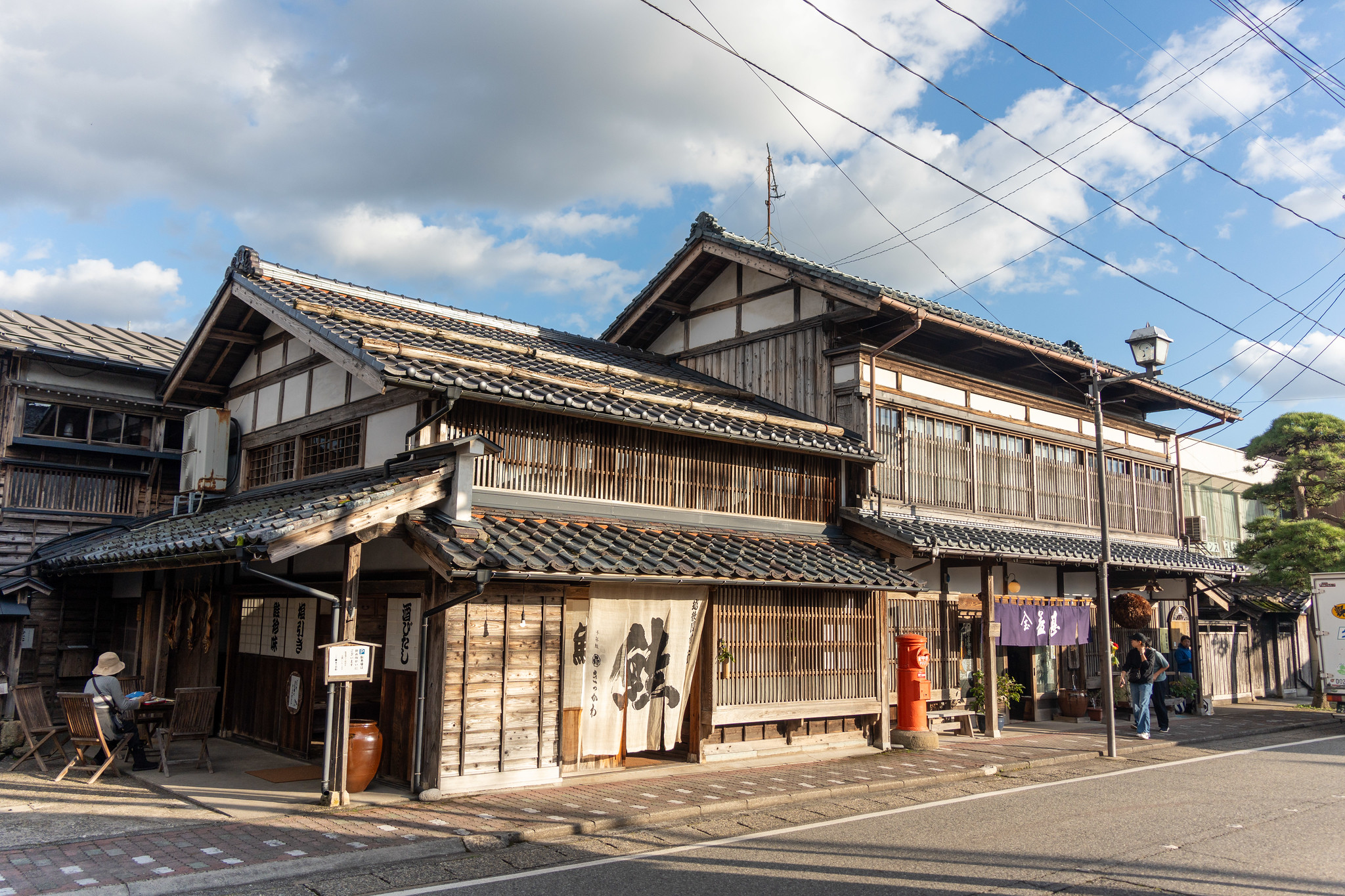
A sake shop stood beside the salmon shop: sake next to sake, since the Japanese word for salmon can also be pronounced “sake.” The owner proudly pointed out the joke. I had the feeling he told it about a hundred times a day. I bought a small bottle from the brewery I had visited earlier and tucked it into my back pocket.
On the way back, I visited Murakami’s salmon museum. It was nearly closing time, and there were few visitors. Salmon biology, the history of salmon cultivation, the tools people had used. Children’s drawings and explanations of salmon dishes: displays that brought the relationship between people and salmon to life. There were even colorful banners proclaiming “Murakami, the Salmon Town,” and a large bronze statue. The enthusiasm was palpable.
Wanting to sit down for a moment, I went into the little theater. At the end of the introductory video, a family brought their hands together in prayer as countless salmon carcasses, their spawning finished, drifted down the river. The sheer number and range of exhibits showed me the breadth of this town’s connection with salmon. That family’s gesture showed me its depth.
To me, salmon had been an everyday commodity, something I ate without thinking about where it came from. But over many years, the people of Murakami had reached a point where their lives and salmon could no longer be separated. A firmly rooted sense of who they were. Whether in a person or a town, I think that kind of individuality is a wonderful thing.
I returned to the hotel through a golden town, in the cool air. Every day was so rich with experience. What a wonderful journey.
