(If you missed the introduction, you should start here.)
There’s something special about starting a bike journey right from your own doorstep. The familiar everyday scenery gradually and seamlessly morphs into the unfamiliar. It’s like one more circle outside the concentric circles of your world, with the home at the center. You get to feel “near” and “far” are actually continuous & connected.
I navigated through Tokyo by threading through narrow back alleys. This metropolis is fascinating like that — there are countless long, continuous backstreets completely bypassed by the major roads. It felt like discovering a brand-new face of this city that I have known for decades.
From a shopping district to a quiet residential area, and then into the next shopping district. Since it was really early morning (I left home 5am), the city was rather quiet. Yet, it’s funny how you can always tell exactly which direction the nearest train station is just by watching the flow of people.
In western Tokyo, a dozen private commuter rail lines radiate outward from the city center like the spokes of a bicycle wheel. Each line carries its own distinct socio-economic vibe, functioning as invisible borders that partition the daily lives and identities of millions. Riding from south to north meant cutting across these distinct cultural layers, one by one, experiencing the shifting pulse of the city. And just like how you can tell where is the nearest train station by watching people’s flow, you can tell which line’s sphere of influence you are in by looking at buses, for every line has its own fleet of buses that serve the neighborhoods along its route.
Eventually, I crossed the major river boundary that marks the edge of Tokyo, the administrative district. Tokyo the metropolis would continue far, far out, but from here on, I was entering uncharted territory — a region I had never explored on a bicycle. I could immediately feel the shift into a car-centric culture. The density of buildings went down noticeably, parking spaces are more noticable, and the number of people on bicycles increased. Feeling these micro-shifts in the atmosphere is exactly what makes long-distance riding so addictive.
I eventually arrived at the capital of this region to discover the shrine. True to its title that this is the most prestigious shrine in this region, a mile-long verdant approach leads to the shrine, and it’s hard to believe that this oasis of greenery exists right in the heart of this dense city with skyscrapers. Shrines are dedicated to gods, but now that I thought about it, perhaps shinto gods might be convenient labels for the collective respect and reverence that many people hold for a particular place. This collective respect serves as a safeguard against human arrogance, preventing us from exploiting everything solely for our own benefit. In that sense, it is true and correct to thank god for protecting this greenery.
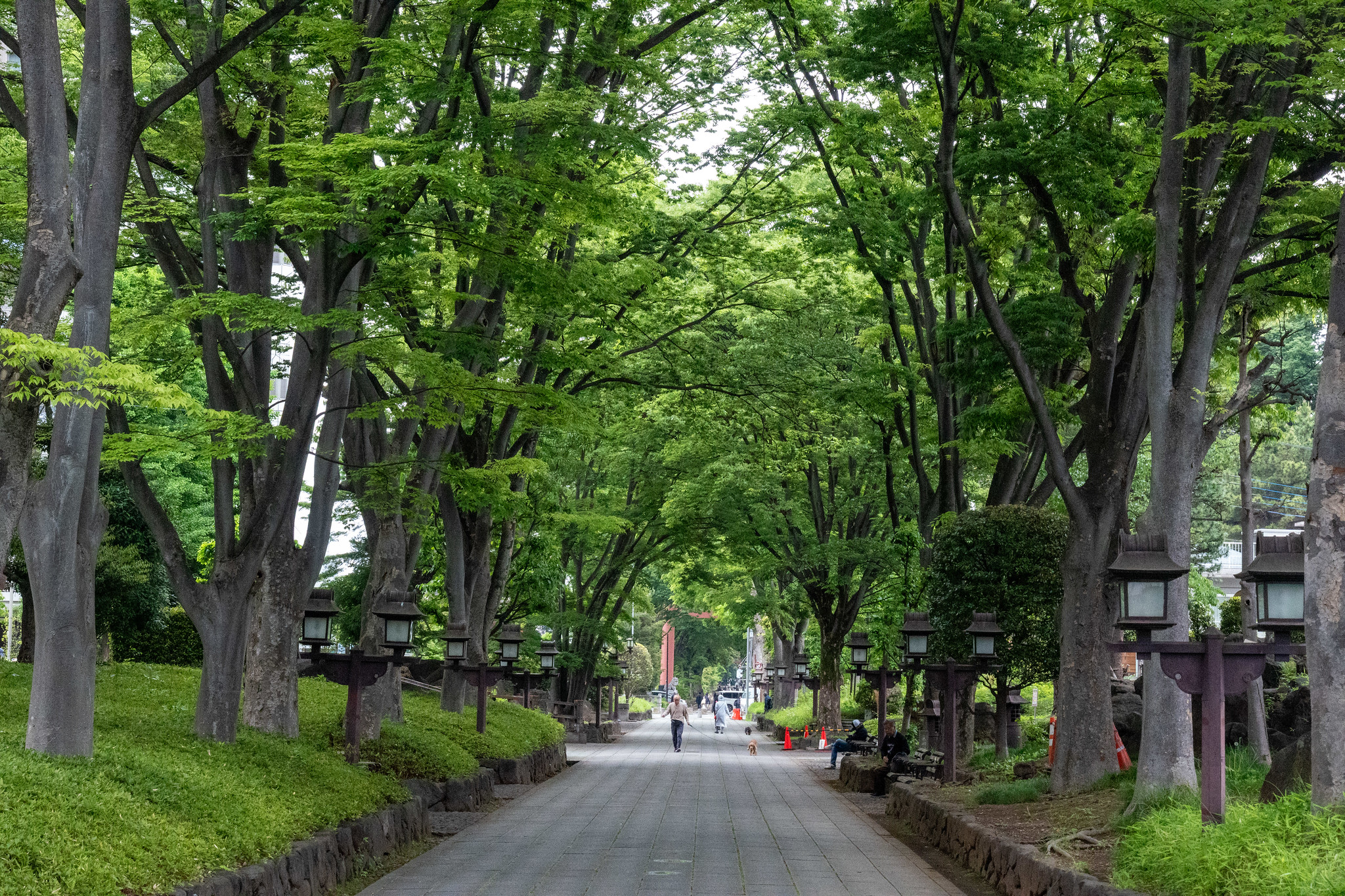
And then, the concrete dissolved completely.
The landscape turned aggressively rural, and I finally had my first encounter in this trip with the rice paddies. This was the week for rice planting — local farmers were busy at work. Looking at the sheer number of tractors buzzing across the fields, they might very well be the most popular vehicles in the country. Every farmer has to have one, in order to use it in the few days that they need them. The rich smell of soil, the chorus of frogs. It is a cycle of the year that has repeated for millennia. That feels like eternity, yet when you think about it, human history here is short. Japanese agriculture goes back maybe 2,000 years—heck, this blog post is already longer than that in character count.
By 10 AM, I was already hungry, so I started seeking food. Given the early hour, my only option was a 24-hour ramen joint sitting right off the major car road. Inside the kitchen, thick clouds of steam were billowing. A full crew of workers was intensely prepping for the impending lunchtime rush. I was mesmerized by the sheer speed and dexterity. I mean, look at the guy who peeled onions out of a cardboard box full of them. A few long-haul truck drivers, looking like regulars, ordered their usuals and quietly slurped their noodles.
Crossing the next major river, a profound sense of “I’ve really come far” washed over me. Just ahead lay an old samurai-era castle town. An area of historic storehouses (kura) had been preserved, so I decided to stop there for a coffee break. Looking out at the white-walled historic architecture through a glass window — spending a peaceful moment just gazing outside while nursing a coffee after being in constant motion—felt extraordinarily indulgent. I walked inside one of the old storehouses and stretched my bare feet out onto the smooth wooden floorboards. An absolute stillness met the soft early-summer light. The perfect contrast between motion and stillness.
As I was leaving, I had that classic exchange with a local older lady. “Where did you ride from?” “Yokohama.” “What?! Yokohama?!” It gave me a little swell of pride and put wings on my back. These tiny, spontaneous interactions on the road are the true joy of traveling.
However, hands down the absolute best encounter of the day happened after the ride, at a craft beer bar. I stepped inside to find a tiny space with just a bar counter and five stools. The three customers inside were all hardcore regulars, chatting casually with the owner. I love blending into these intimate circles, and they seemed genuinely intrigued by my cycling gear, so we hit it off immediately. It was an incredibly fun time. The owner told me he only had three taps, but because he brews in extremely small batches, the beer changes almost every time you visit. True to his word, right while I was there, one keg blew, and he swapped it out for a completely different brew.
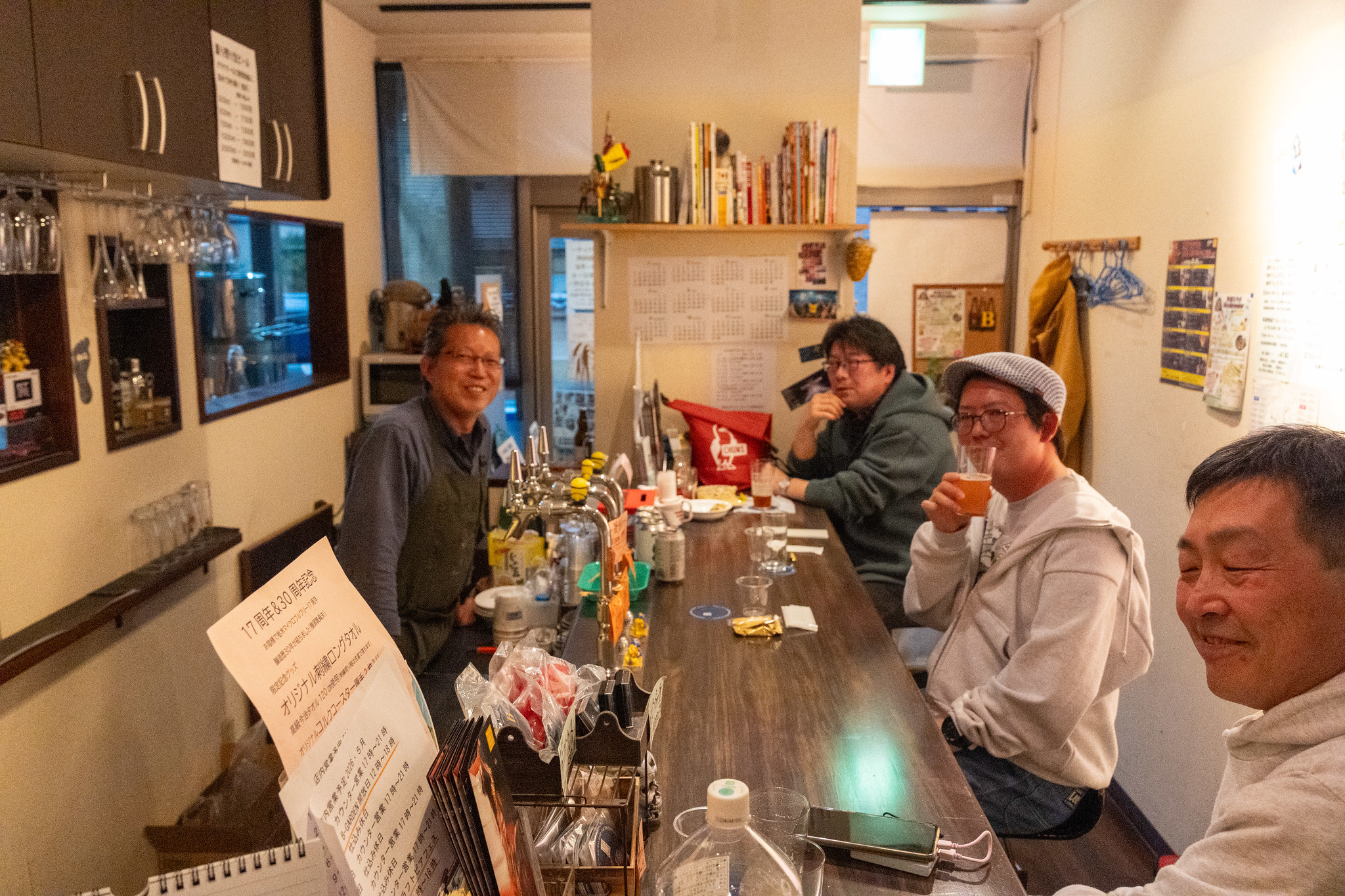
Furthermore, here, the customers brought their own beers to share with everyone. A regular opened a fresh can of craft beer he had picked up earlier that day, and the owner opened three pre-release prototypes from a new tropical island brewery from southern Japan he’s mentoring. I got to join the tasting. Everyone was doing it because they desperately wanted to hear the feedback of the owner, a man who has been brewing beer for 30 years and running his independent shop for 18.
He spoke quietly but with immense authority. He explained that in craft brewing, the first step is eliminating obvious flaws in the production process. If it’s a pale ale, it needs to taste like a pale ale; if it’s a weizen, it needs to hit the markers of a weizen. Getting that alignment between the name and the product gets you to a 50-point baseline. “And this,” he said earnestly, “has nothing to do with whether the beer tastes ‘good’ or ‘bad’ yet. It’s just the table stakes for it to exist as a product.”
It was a masterclass in brewing philosophy, and everything he said was riveting. Time just flew by. I had promised to meet a couple from my university days for dinner, so I eventually had to tear myself away, though a part of me really wanted to stay.
I thought I was the one who had stumbled into an extraordinary place, but when I casually mentioned that I was the creator of Jenkins, one of the regulars gasped, knowing exactly what it was. Hearing him say, “Wow, an extraordinary man just walked into our bar!” was hilarious and deeply humbling. Well, that’s my line.
In an unfamiliar city, I felt completely embraced by a tight-knit, warm community of friends.
Lately, I’ve come to realize that a journey isn’t about the destination; it’s entirely about the miles in between. I travel precisely for these unexpected encounters along the way. Ever since adopting this mindset, the way I travel has completely evolved.