(If you missed the introduction, you should start here.)
With a gentle early-summer breeze pushing me from the south, I headed straight north along the river. Scattered throughout the landscape were traditional old houses featuring distinct, steeply pitched roofs. Looking at them, you could easily tell that this region gets buried in deep snow during the winter.
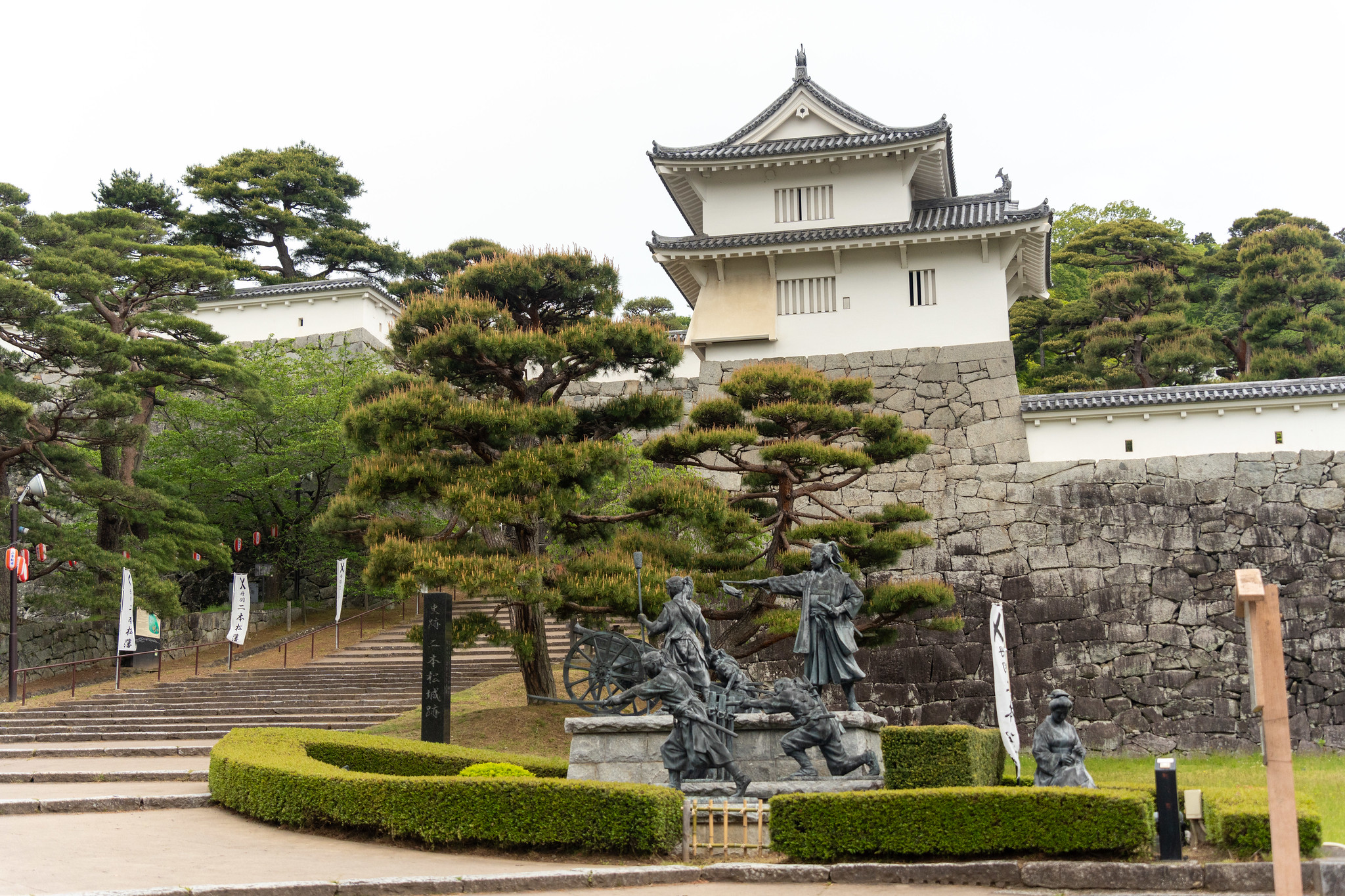
Eventually, I rolled into a city famous for being a major battlefield during Japan’s 19th-century civil war—a historical fact I had researched before the trip. I climbed all the way up the mountain, pushing my bicycle up a rugged gravel path to visit the ruins of the old castle tower.
Reflecting on the history I studied beforehand, one profound thought kept echoing in my mind: the people of the North were beautifully, tragically stubborn. Clinging to their old-school samurai honor and a deep sense of gratitude to the falling dynasty, they chose to fight to the death against the Imperial coalition—a highly modernized, Westernized government force equipped with rapid-fire rifles. Had they been pragmatic enough to read the room and see which way the geopolitical wind was blowing, this tragedy could have been entirely avoided. Yet, this land has seen this exact kind of heartbreaking history repeat itself over and over. Still, there is something incredibly endearing about that fierce, unyielding northern spirit. I can’t help but love them for it.
As a descendant living in a modern, independent Japan born from that Imperial coalition’s victory, I am infinitely grateful for the massive modernization they achieved. And yet, when it comes to what actually moves the human heart, it is never the final outcome—it is always the journey itself. It’s exactly like traveling on a bicycle.
Right below the castle, I stumbled upon a traditional Japanese confectionery shop that has been running for an astonishing 16 generations. I treated myself to an Ichigo Daifuku (a fresh strawberry wrapped in sweet red bean paste and mochi). It absolutely lived up to its 16-generation legacy; the mochi possessed an otherworldly, cloud-like softness.
I’ve previously complained about the bizarre fact that coffee shops refuse to open early in Japan, but what is equally mysterious is that traditional wagashi shops open at the crack of dawn. I have no idea why, but for a cyclist desperately hunting for calories, it is an absolute godsend.
Noticing several road signs nearby, I decided to take a spontaneous detour to the birthplace of a pioneering artist and poet, a woman who stood at the forefront of Japan’s early feminist movement. I had previously listened to a podcast about her contemporaries, so I had some basic context. It made me realize just how agonizingly difficult it must have been for a woman to forge her own path in that era. Honestly, that immense societal pressure was likely one of the triggers that eventually drove her into schizophrenia.
What struck a deep, emotional chord with me was the gallery of her paper-cutting artwork, which she created continuously from the onset of her illness until her death. When you think of an artist consumed by schizophrenia, Van Gogh immediately comes to mind. Even as they watch their own existence crumble away, which is the literal definition of schizophrenia, they are still gripped by a relentless drive to create—even if it means tearing their own souls apart. That absolute perseverance with making things resonated deeply with my own identity as a creator who simply cannot stop building things. Furthermore, comparing their expressions of madness, Van Gogh’s felt intensely masculine, whereas hers felt profoundly feminine. Some things are so deeply rooted that even advancing schizophrenia can’t take it away. It was a deeply meaningful detour that I hadn’t planned at all.
For lunch, I stopped at a ramen shop founded in 1954. I later found out it’s a popular local chain with multiple locations, but what I loved most was the nostalgia plastered across the walls—vivid, sensory descriptions of the vibrant, hopeful era of Japan’s post-war reconstruction. It was storytelling that truly triggered all five senses, making me wish I could write prose that evokes that kind of raw emotion.
As I passed through the next town, I made a stop at an ancient earthen defense wall built in the 12th century. This was the site of a colossal, historic battle for the independence of the North, where a northern clan clashed with a massive invading army from the south. Here too, the northern people painstakingly spent months preparing their defenses, only to be completely crushed by the central Japan. Ah, the tragedy of the stubborn northerners didn’t start with the 19th-century civil war; it dates back a millennium.
A sign near the wall indicated that a small historical museum was located just a short distance away, so I decided to check it out. The museum turned out to be nothing more than a single room inside a shuttered elementary school. With Japan’s shrinking population, especially bad in rural areas, the local community had clearly built this beautiful, grand school building out of a desperate, loving hope for their children’s future. Yet, despite those earnest wishes, the children vanished anyway.
Standing in the completely empty schoolyard, beautifully decorated with the ritual carp streamers meant to wish for healthy growth of children, fluttering lonely in the wind, a profound tightness gripped my chest. It was heartbreaking.
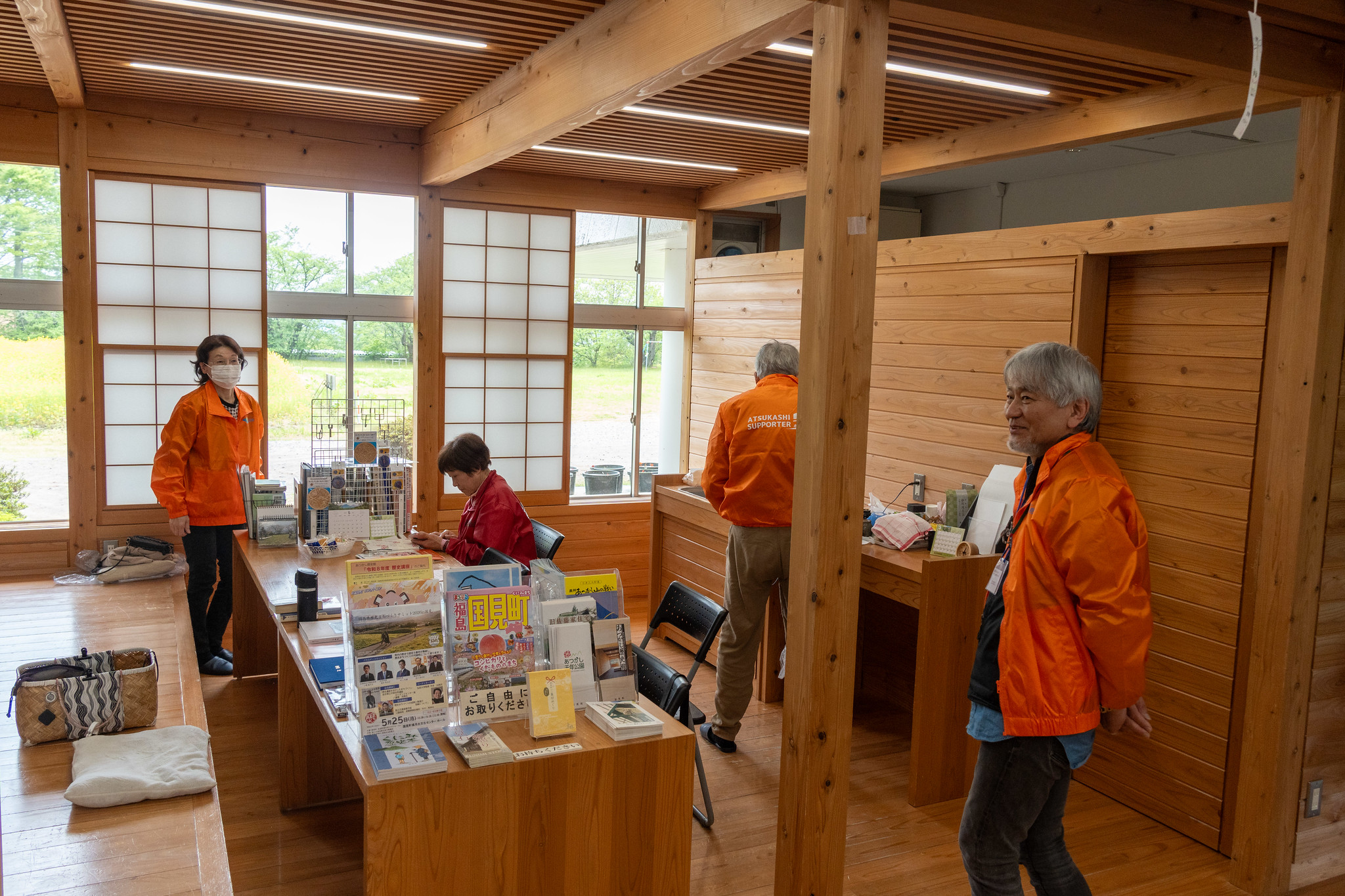
Despite it being such a tiny exhibition room, for some reason, four staff members were there that day. When they found out I had ridden all the way from Yokohama on a bicycle, they were absolutely thrilled and even brewed me a fresh cup of coffee. The kindness of people in rural Japan is boundless.
Further down the road, I stopped at another roadside sweet shop for sweets. The second-generation owner nearly jumped out of his skin with surprise when I told him about my bicycle journey from the south, and he happily chatted with me for quite a while. Anko gives your muscles energy, but these warm, spontaneous conversations are what truly recharge your soul.
From this point on, the river becomes tightly squeezed by steep mountains on both sides as it rushes down toward the vast coastal plains. I had expected the road running alongside it to offer spectacular views. However, a series of modern tunnels had recently been bored straight through the mountains. Great for cars, no doubt, but an absolute nightmare for bicycles. Even with my lights fully blaring, the deafening roar of traffic echoing off the concrete walls amplified the fear of being struck from behind. I was on edge the entire time. And no views to enjoy.
Once I finally escaped the mountains, I visited a museum that was once the grand estate of a wealthy 19th-century local merchant. He had amassed a fortune through textiles and silk cultivation, which made me realize just how massive the economic impact of the river’s boat trade used to be. The museum was delightfully filled with charming anecdotes about the successive heads of the family—like how one patriarch was absolutely terrified of thunder, or how another was so obsessed with new gadgets that he bought up early automobiles just to joyride around the village. It left me with a warm smile.
In the neighboring town across the river, I toured another magnificent mansion, this one belonging to a wealthy 20th-century landowner. The stunning architecture from the early Showa era was beautifully preserved, offering a fascinating window into the past. It made me wonder: were there simply numerous wealthy merchants scattered across this region back then, meaning the area was incredibly affluent as a whole, and these two estates just happened to survive? Or was there an economic systemic flaw that naturally allowed a single individual to monopolize the entire wealth of the village?
Today’s ride was a relatively short 120km, and thanks to a favorable tailwind, I arrived at my inn with plenty of time to spare. After doing my laundry, I eagerly waited for a local craft beer brewery and beef tongue restaurant to open for dinner. I devoured three massive bowls of rice and enjoyed three pints of beer.
It completely blows my mind that even a tiny country town like this has its own dedicated craft brewery. The elderly gentleman serving the beer had a wonderfully warm smile that made the end of the day feel incredibly welcoming.